LE GRAND JEU: CAROLYN MURPHY, CANNES, AND MARIO TESTINO’S THEATRE OF GLAMOUR


When Vogue Paris published its September 2003 issue, the magazine was already operating with a distinct editorial confidence under editor-in-chief Carine Roitfeld. Fashion was no longer simply about garments photographed in isolation. It had become theatre: location-driven, character-led, and open to the friction of real life. Le Grand Jeu, the cover story photographed by Mario Testino and styled by Roitfeld, sits squarely within that moment.
Shot in Cannes with Carolyn Murphy at its centre, the editorial unfolds along the promenade and inside the Carlton Hotel, where glamour, eccentricity and passing strangers blur into a kind of social choreography. Murphy appears throughout not as a distant ideal but as a figure moving through the scene, observed and observing in return. The title itself suggests performance and risk. In Testino’s hands it becomes something more precise: a study in how fashion can absorb the unpredictability of public life without losing its composure.
What makes Le Grand Jeu distinctive is the world built around Murphy. Reflecting on the shoot, Testino describes Cannes as “a very eccentric place made out of many different nationalities,” a promenade where the boundaries between spectacle and daily life blur naturally. The team approached the location almost as an open stage. Passersby were invited into the photographs, including a Danish man dressed as a cowboy, a group of bodybuilders, and even a man who had simply stepped out to buy a baguette.
Murphy, Testino recalls, played “an eccentric in the south of France,” moving through this shifting cast with ease. These encounters were not accidents to be edited out but material to be absorbed. The editorial allows ordinary life to seep into the frame, creating a porous form of fashion photography where chance and control meet in the same image. The result is an atmosphere that feels alive rather than sealed.


Le Grand Jeu, Vogue Paris, September 2003, p.226. Carolyn Murphy photographed by Mario Testino in Cannes.


Le Grand Jeu, Vogue Paris, September 2003, p.221. Carolyn Murphy photographed by Mario Testino in Cannes.


Le Grand Jeu, Vogue Paris, September 2003, p.220. Carolyn Murphy photographed by Mario Testino in Cannes.

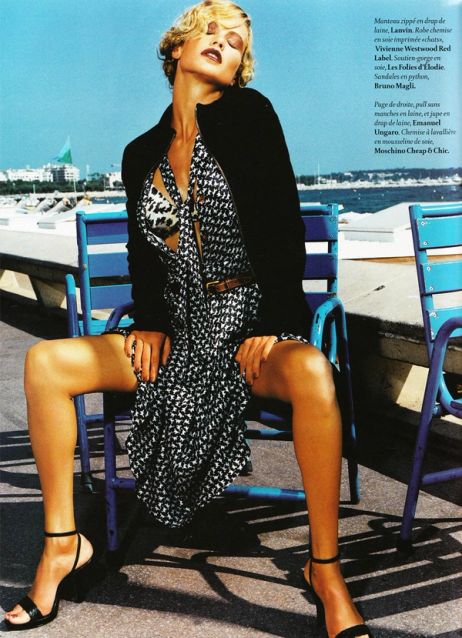
Le Grand Jeu, Vogue Paris, September 2003, p.222. Carolyn Murphy photographed by Mario Testino in Cannes.

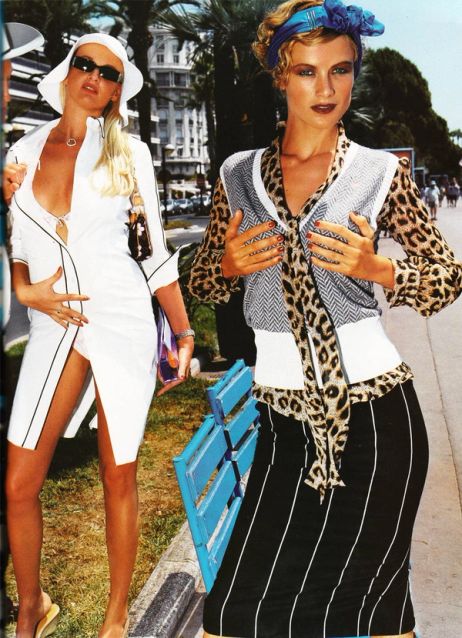
Le Grand Jeu, Vogue Paris, September 2003, p.223. Carolyn Murphy photographed by Mario Testino in Cannes.

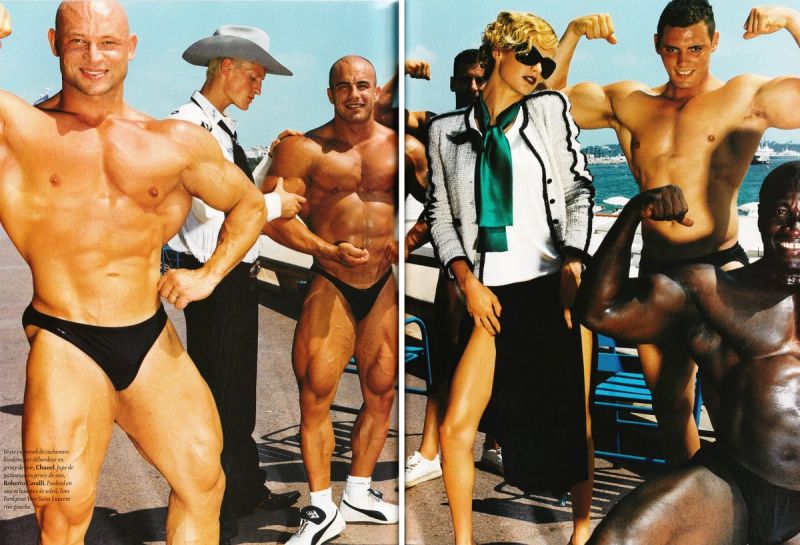
Le Grand Jeu, Vogue Paris, September 2003, p.224-225. Carolyn Murphy photographed by Mario Testino in Cannes.

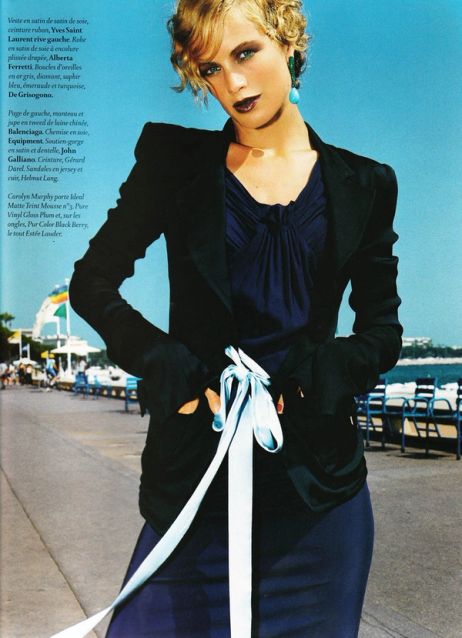
Le Grand Jeu, Vogue Paris, September 2003, p.227. Carolyn Murphy photographed by Mario Testino in Cannes.


Le Grand Jeu, Vogue Paris, September 2003, p.228. Carolyn Murphy photographed by Mario Testino in Cannes.


Le Grand Jeu, Vogue Paris, September 2003, p.229. Carolyn Murphy photographed by Mario Testino in Cannes.
The method behind that looseness was anything but casual. The photographs were made on film and retouched by hand, part of the slower, tactile workflow that still defined fashion photography in the early 2000s. Testino worked closely with the Paris-based retoucher Jocelyn Bedell, sending prints back and forth and refining them through successive adjustments until the image reached the right register.
He remembers directing the process patiently while waiting for “the prints to come back from Paris,” guiding each correction until the tone of the image felt resolved. Skin, he notes with characteristic humour, often needed to move from “completely red” toward something more “sun-kissed rather than a lobster.” Beneath the anecdote lies a philosophy of image-making. Testino has often described his approach as one of reduction, comparing it to algebra: simplifying a complex equation until only the essential elements remain.
Le Grand Jeu may appear spontaneous, crowded with bodies and incidental figures, but its structure is carefully resolved.Murphy’s role within that structure is central. By 2003 she had already established herself as one of the defining American models of her generation, yet Testino places her here in a slightly different register. She moves through Cannes with a lucid detachment, both participant and observer, as though the spectacle unfolding around her belongs partly to her and partly to the city itself. That duality gives the story its charge.

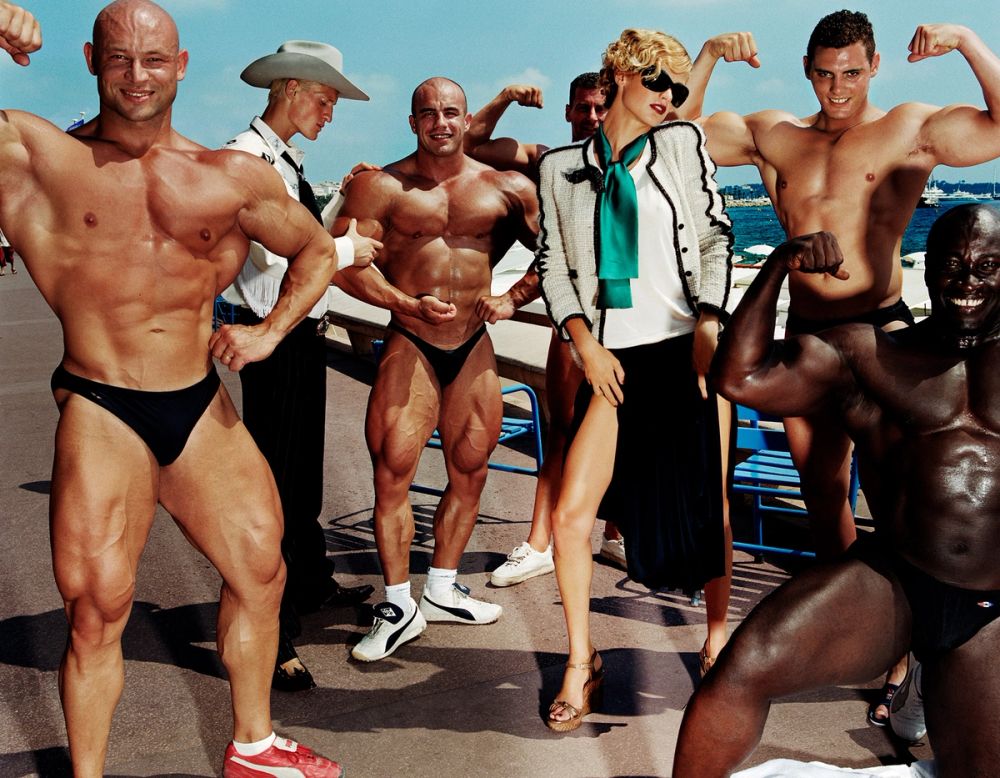
Carolyn Murphy, Cannes, Vogue Paris, 2003. Photographed by Mario Testino
In one photograph Murphy stands alongside a group of bodybuilders, their exaggerated physiques pushing against the controlled elegance of the fashion image. The tension between glamour and excess is deliberate. Years later the image would take on a second life when it entered In Your Face, Testino’s exhibition at the Museum of Fine Arts, Boston, before travelling internationally, and when it appeared in the 2012 Taschen book of the same name. What began as editorial theatre had already crossed into the longer memory of the archive.
Seen today, Le Grand Jeu occupies a revealing place within Testino’s broader body of work. It belongs to the period when fashion photography still moved through editorial judgment, craft and patient construction. Yet it also hints at instincts that would later expand in other directions. The fascination with group dynamics, the interplay between individual presence and collective spectacle, and the sense that a place can organise bodies into temporary theatre all appear here in early form. These interests would later surface in very different contexts, from ceremonial portraiture to the global cultural observations of A Beautiful World. In Cannes they remain tied to glamour, sharpened by the pleasures of performance.

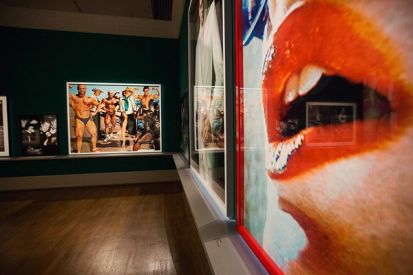
Installation view of 'Carolyn Murphy, Cannes, Vogue Paris, 2003' by Mario Testino at the In Your Face exhibition at the Kunstbibliothek in Berlin, Germany, 2015.

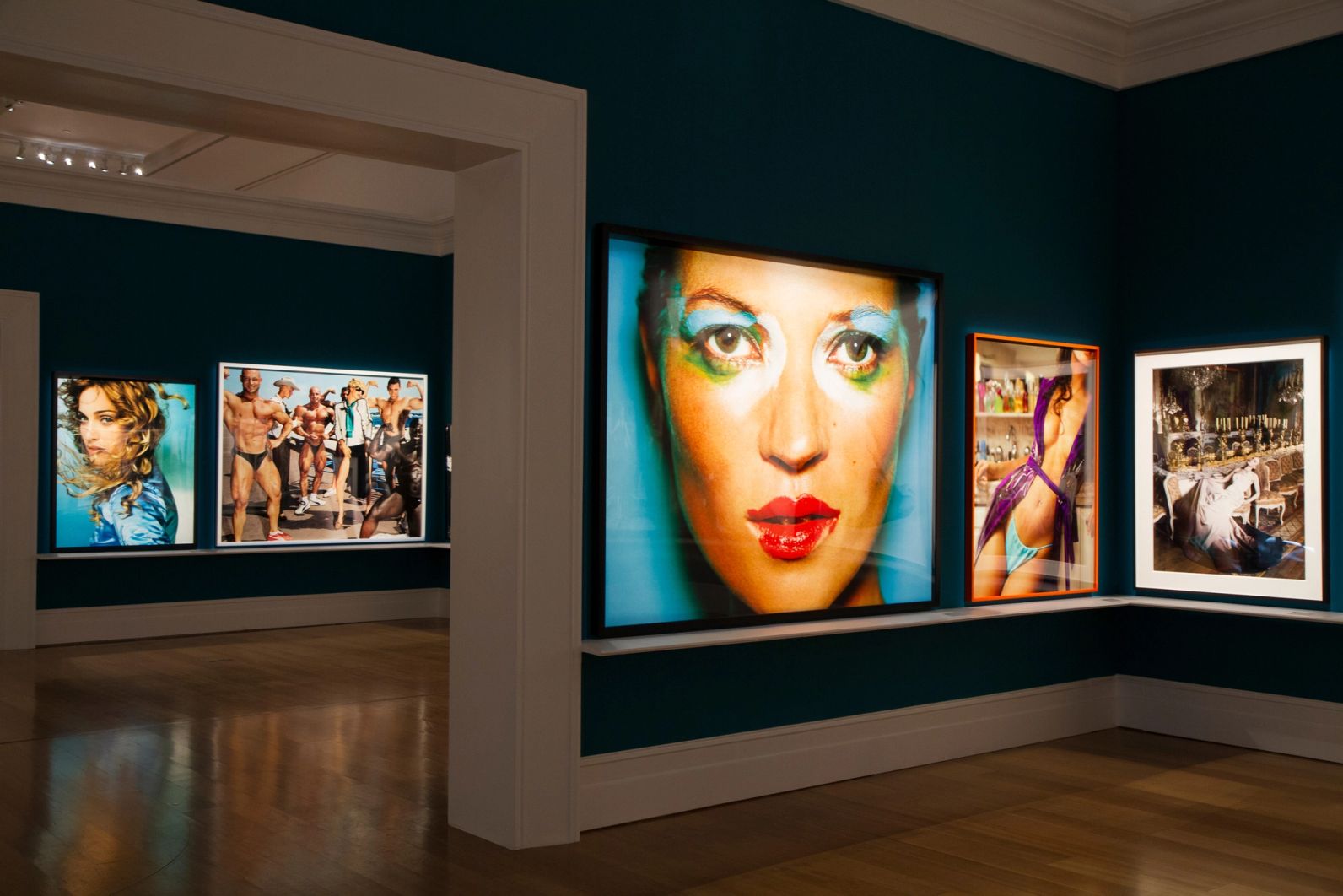
Installation view of 'Carolyn Murphy, Cannes, Vogue Paris, 2003' by Mario Testino at the In Your Face exhibition at the Museo de Arte Latinoamericano de Buenos Aires, 2014.


Installation view of 'Carolyn Murphy, Cannes, Vogue Paris, 2003' by Mario Testino at the In Your Face exhibition at the Museo de Arte Latinoamericano de Buenos Aires, 2014.
The collaboration between Testino and Murphy would continue to produce memorable images, including the celebrated Harper’s Bazaar photograph already discussed elsewhere on MT World, often read as a tribute to Liz Tilberis. That earlier image distilled Murphy into stillness and light. Le Grand Jeu, by contrast, opens the frame outward until atmosphere becomes part of the cast. Together they reveal the range that made Murphy such a compelling subject for Testino: the ability to move from restraint to spectacle without losing clarity of presence. More than two decades later, the editorial still holds because it captures something fashion rarely achieves with such precision. A world both composed and open, where glamour meets the unpredictable theatre of life and the photograph remains perfectly balanced between the two.
CREDITS: STYLIST: CARINE ROITFELD. MAKEUP: TOM PECHEUX. HAIR: SAM MCKNIGHT