MARIO TESTINO AND MALBA: A STORY TWELVE YEARS IN THE MAKING

The company a photograph keeps can change the way it is seen. In a magazine, it belongs to an issue, a story and a particular moment. In a museum collection, other relationships begin. This year, two photographs by Mario Testino enter the collection of the Museo de Arte Latinoamericano de Buenos Aires (MALBA) alongside new additions by Juan Del Prete, Líbero Badíi, Jorge Pineda and Margarita Paksa. Across generations and disciplines, their work now enters into a different kind of conversation. For Testino, there is another connection: these photographs have been here before.
Twelve years earlier, the photographs were among 122 works selected by Testino for MARIO TESTINO: IN YOUR FACE, his first exhibition in Argentina. First presented at the Museum of Fine Arts, Boston in 2012, IN YOUR FACE brought together more than three decades of Testino’s photography, moving between fashion and advertising images, formal portraits and personal snapshots rather than separating those different parts of his practice. When the exhibition travelled to MALBA in Buenos Aires in March 2014, it took on a different character.
“As a South American, I was very proud to bring IN YOUR FACE to MALBA. It is a museum of such high quality, not only in the exhibitions it presents, but in the architecture and the way everything is put together.”

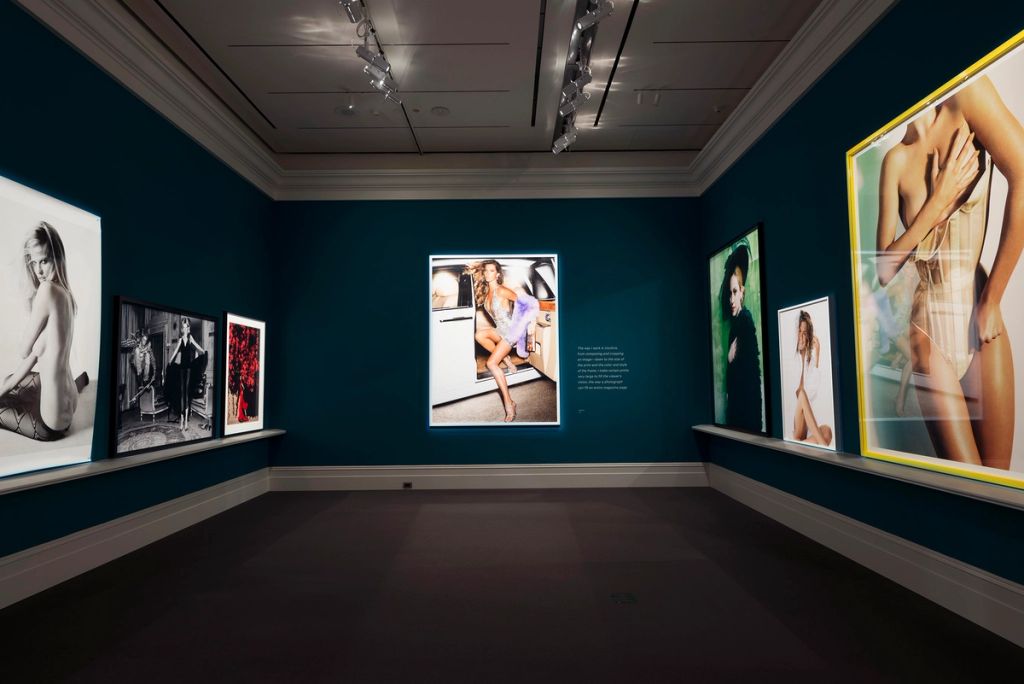
Installation view of Mario Testino: In Your Face at the Museum of Fine Arts, Boston, 2012. The exhibition was first presented in Boston before travelling to MALBA in Buenos Aires in 2014.
“One of the things that really caught my attention was the quality of the floors. I remember these beautiful, shining floors, and when I saw the pictures and footage of the exhibition, they gave the whole show a completely different effect from the other places where we had exhibited it.”
IN YOUR FACE had been conceived around precisely this kind of proximity. Rather than following a chronology, Testino sequenced formal portraits beside private snapshots, nudes beside fashion, and black-and-white photographs beside colour, allowing one image to provoke a reaction to the next. At MALBA, those photographs occupied the museum’s second floor, their scale, sequencing and reflections becoming part of a new installation.
“The exhibition had originally been created in Boston, and it was incredible to see how it transformed when we brought it to Buenos Aires,” Testino remembers. “The architecture and the character of MALBA gave the work another dimension.”
“There aren’t that many institutions in South America with that level of commitment and attention to detail. The Costantinis have created something very special, so seeing my work presented there was a wonderful experience.”
Buenos Aires responded strongly. Over its three-month run, 119,500 people visited IN YOUR FACE. MALBA described it at the time as one of the most attended exhibitions in the museum’s history. For Testino, however, the character of that response was as memorable as its scale.
“I remember being particularly struck by the response to the exhibition in Argentina. The journalists had an extraordinary awareness of art and fashion, and they knew my work in great depth. The questions they asked and the way people reacted to the photographs surprised me.”
The opening and the months that followed placed the exhibition within the cultural life of Buenos Aires. Crowds moved through the galleries, journalists and guests gathered around the photographs, and an exhibition that had begun in Boston acquired a different audience and context in Argentina. By the time it closed in June 2014, MALBA had also seen visitors sharing their own encounters with the exhibition extensively online, extending the experience beyond the museum.
That might have been the end of MALBA’s relationship with these particular works. Instead, twelve years later, the relationship has taken another form.
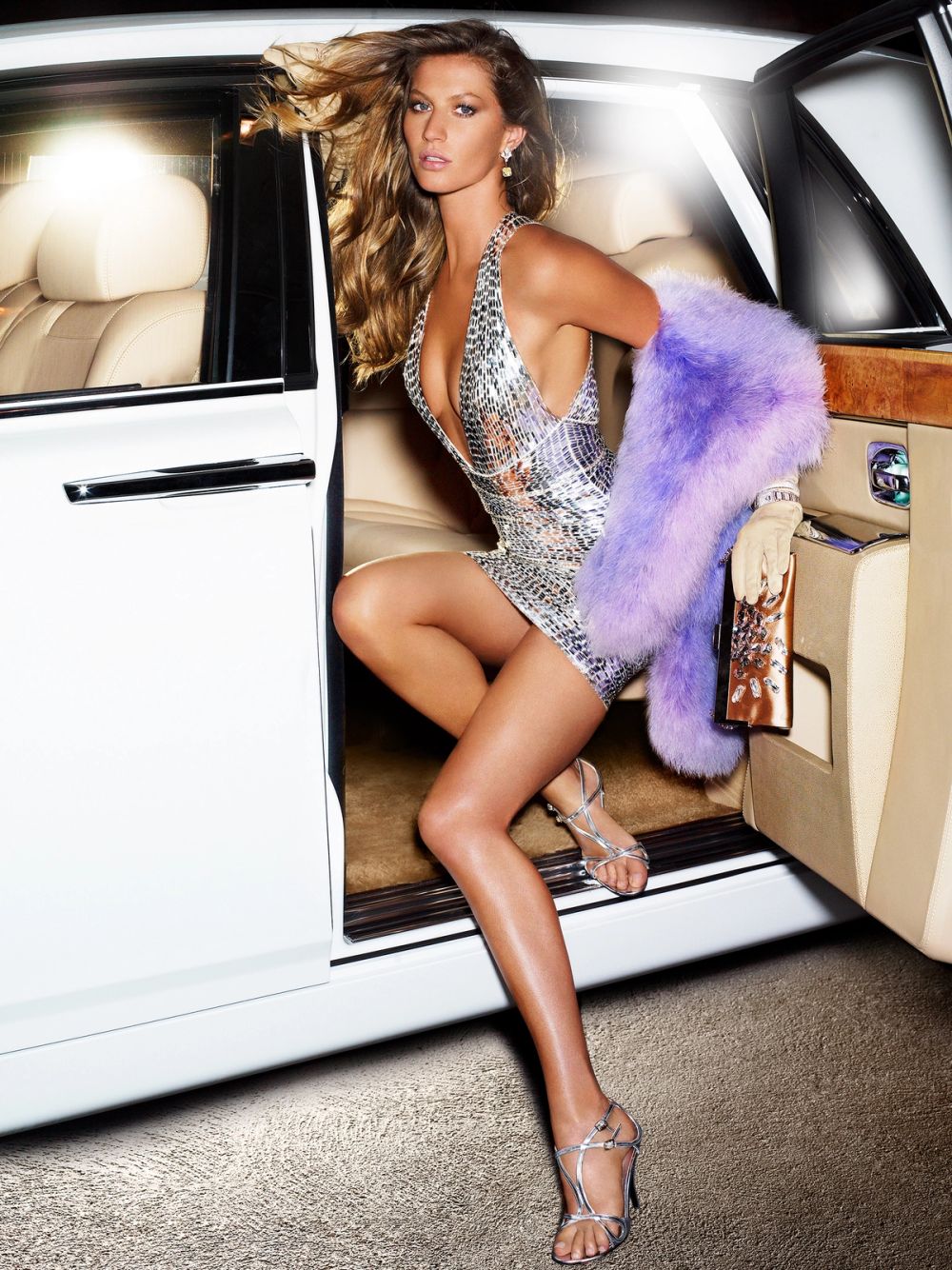
The two works entering MALBA’s collection are GISELE BÜNDCHEN, NEW YORK, VANITY FAIR (2007), a 240 × 180 cm C-print, and SIENNA MILLER, ROMA, AMERICAN VOGUE (2007), a 126 × 166 cm C-print. Both were donated by Testino, but donation alone does not determine what enters the museum’s collection: proposed donations are evaluated and selected by MALBA’s curatorial team before being incorporated.

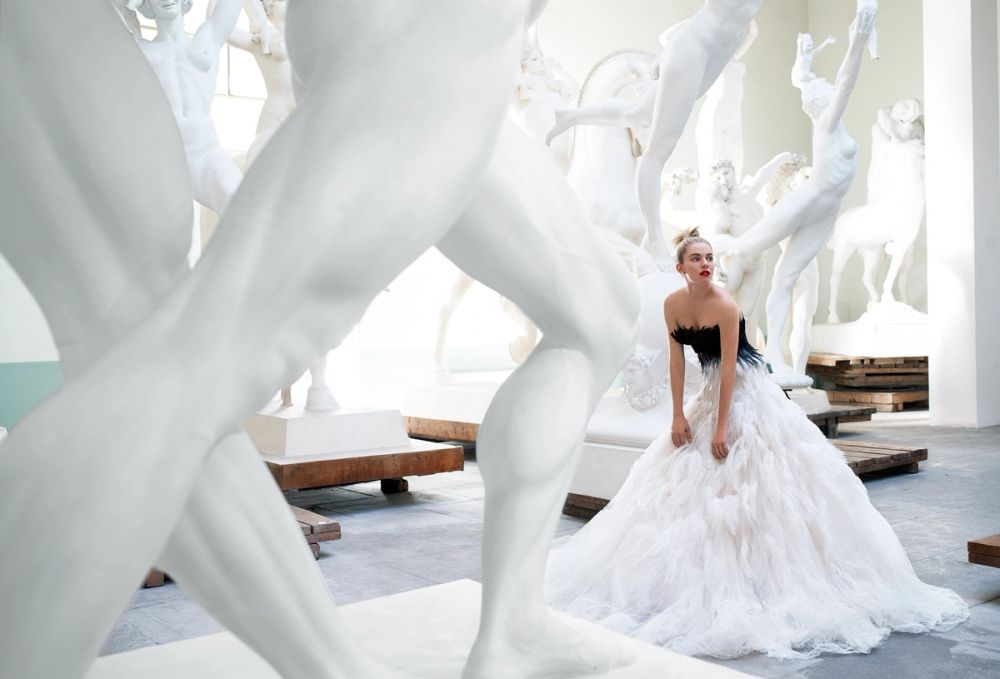
Sienna Miller, Roma, American Vogue, 2007. C-print, 126 × 166 cm. Donated by Mario Testino to the MALBA collection in 2026.
For Testino, the two photographs were chosen because they reveal different ways in which he has approached fashion.
“I chose these two pictures because they represent two important aspects of my fashion work. Gisele coming out of the car represents the woman at her maximum expression: strong, glamorous, powerful. The photograph of Sienna Miller is much more about the relationship between the person and the environment.”
In the photograph of Gisele Bündchen, made in New York for VANITY FAIR in 2007, the emphasis is concentrated on the woman herself. Bündchen emerges from a car with the kind of heightened glamour that Testino has often explored through fashion, where clothes, gesture and personality meet in a single moment.
Sienna Miller, photographed in Rome for AMERICAN VOGUE that same year, offers another way of constructing a woman in a photograph. Here, the setting is integral to the image.
“I’ve always used architecture and surroundings to help define the person I’m photographing: what kind of woman she is, where she lives, what world she inhabits,” Testino explains. “These two photographs approach fashion differently, but together they say a lot about the way I have looked at women and fashion throughout my career.”

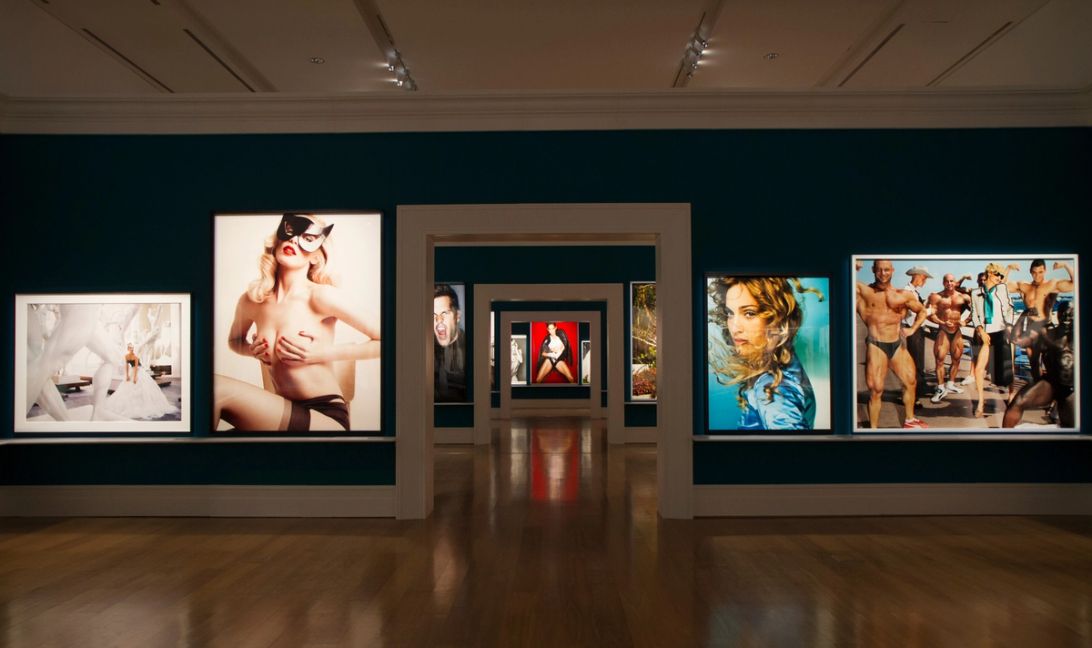
Installation view of Mario Testino: In Your Face at MALBA, Buenos Aires, 2014. The exhibition presented 122 photographs selected by Testino.
The reason these works have now entered MALBA’s collection begins with another institution and another South American city.
“When I closed MATE, my museum in Peru, I wanted some of those works to remain in South America,” Testino says. “MALBA felt like a natural place for them, particularly because of the relationship we had developed when we did the exhibition there.”
Testino founded MATE in Lima in 2012, after spending much of his career working in Europe and North America. The institution created a permanent cultural presence for his work in Peru while also developing exhibitions and programmes around Peruvian and international artists. MALBA itself noted the creation of MATE when it introduced Testino to its Argentine audience in 2014.
Following MATE’s closure, Testino saw an opportunity for works held there to continue their lives within other institutions.
Neither photograph was made in Peru or Argentina. One came out of a shoot in New York and the other from Rome, both created for American publications within an international career. Yet the photographer who made them was born in Lima, and Testino has increasingly considered where that internationally produced body of work sits within the cultural landscape of the continent he comes from.
“I am South American, but I made most of my career in Europe and North America,” he says. “Because of that, I have always felt it was important that my work also forms part of the cultural history of the continent I come from.”
“To have the photographs in a major Latin American collection connects the work back to where I am from. For me, it is important to be represented within the history of photography and image-making in South America, not only in the places where I built my career.”
Now the relationship between artist and institution has moved from a temporary exhibition to the museum’s collection.
“There is something very satisfying about the photographs returning permanently to a place where they were once exhibited,” Testino says. “They were part of an exhibition at one moment, and now they become part of the museum’s history and its collection for the future.”
Twelve years ago, the photographs came to Buenos Aires as visitors. This time, they stay.