BEAUTY BEYOND THE FAMILIAR: MARIO TESTINO AND BUTOH

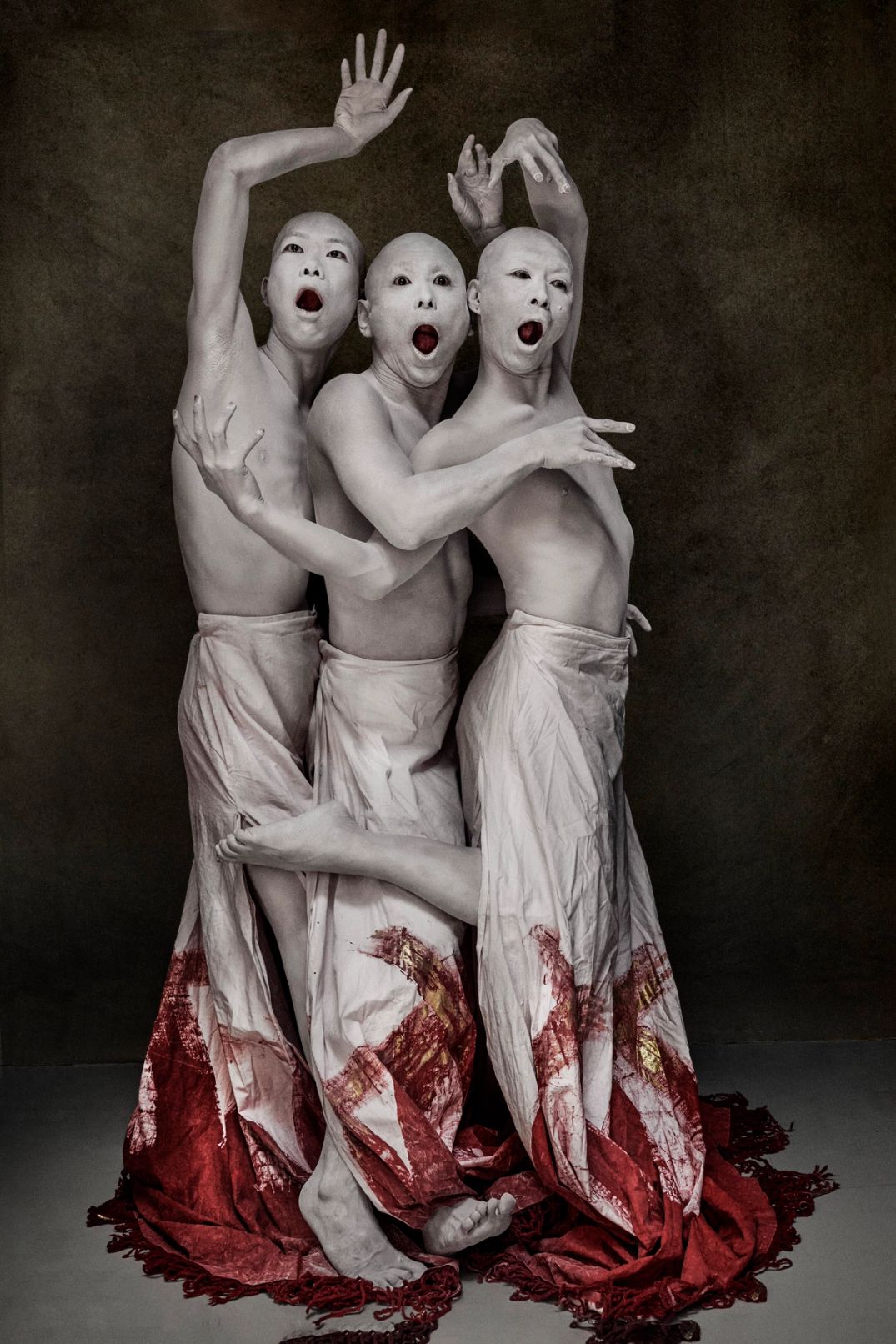
Three figures emerge from a dark, textured background, their faces painted a ghostly white, mouths parted, eyes lifted. Their bodies are entangled in an extraordinary arrangement of limbs. One arm reaches towards the sky, another curves above a head, while hands seem to appear from places they cannot possibly belong. It takes a moment to distinguish one dancer from the next.
Their long white skirts fall from the waist, gathering in soft folds before giving way to vivid red towards the hem. The colour spreads through the fabric from around the calves, intensifying as it reaches the floor, where the material collapses into a mass of crumpled, tissue-like layers. Above this strange, almost liquid accumulation, the dancers' pale torsos rise in a composition that feels at once exquisitely controlled and on the verge of coming apart.
These are the performers of Butoh Ishii Gumi, a Japanese dance company photographed by Mario Testino for A Beautiful World. Their extraordinary coordination fascinated him, but so did the philosophy behind their movements.
“It is not just a performance but a way of thinking and living. And the perfect coordination between their minds also is wonderful,” Mario observed.
For Norihito Ishii, the company's founder, a dancer must first let go of the person they ordinarily are. They must become blank, empty, free of everything they think they know about themselves. Only then can movement begin. The body might become wind, water or the final lingering trace of an emotion. It might express something for which there is no name.
Look again at the photograph and the figures begin to feel different. What first appears to be an elaborate arrangement of bodies becomes something more difficult to define. Each gesture seems to belong to something larger than the individual making it. Three people, each with a distinct expression, appear to share a single impulse. The photograph holds them still, yet their movements seem to continue beyond its edges.

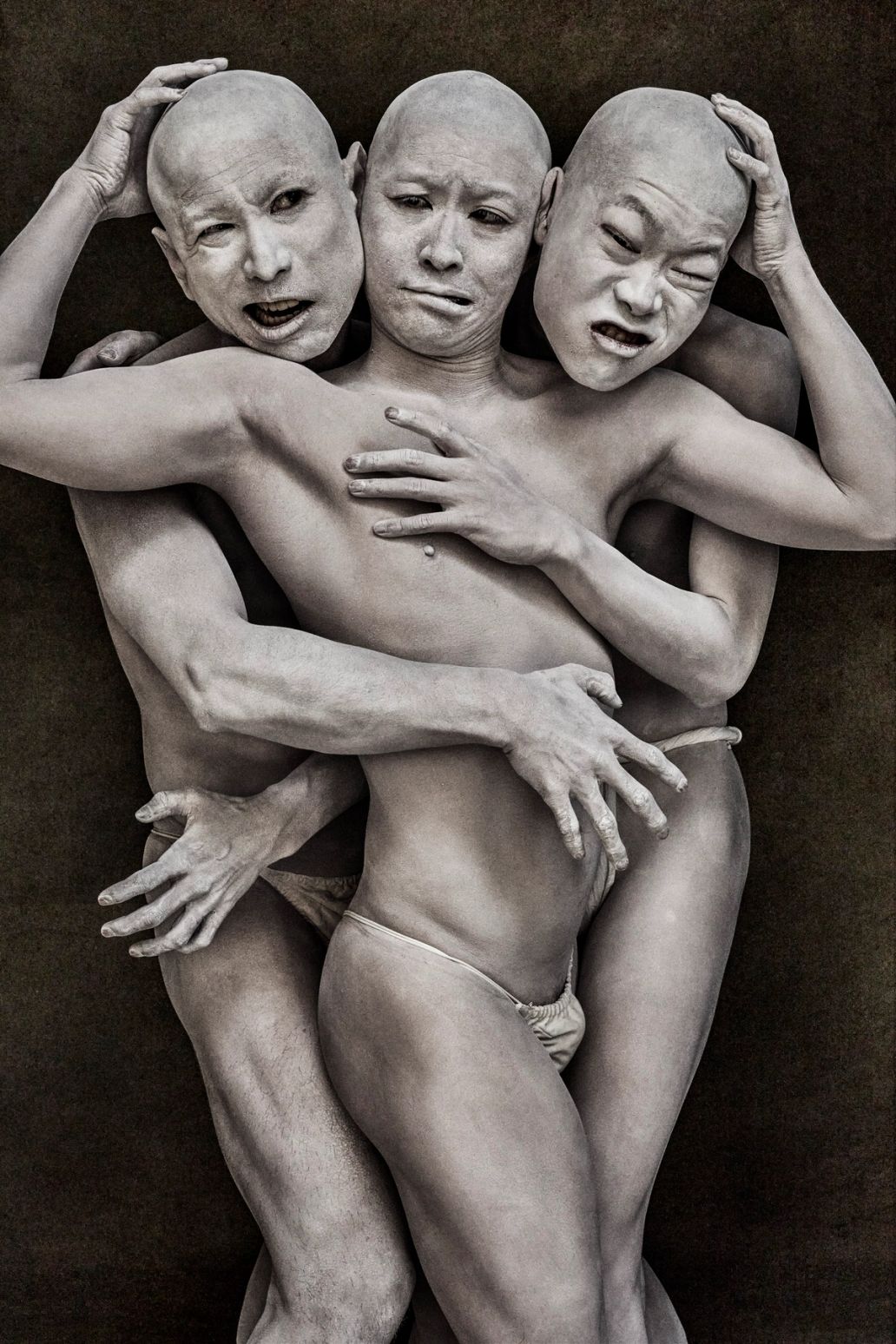
Butoh Ishii Gumi photographed by Mario Testino for A Beautiful World. Three dancers form an intricate arrangement of bodies, hands and expressions.

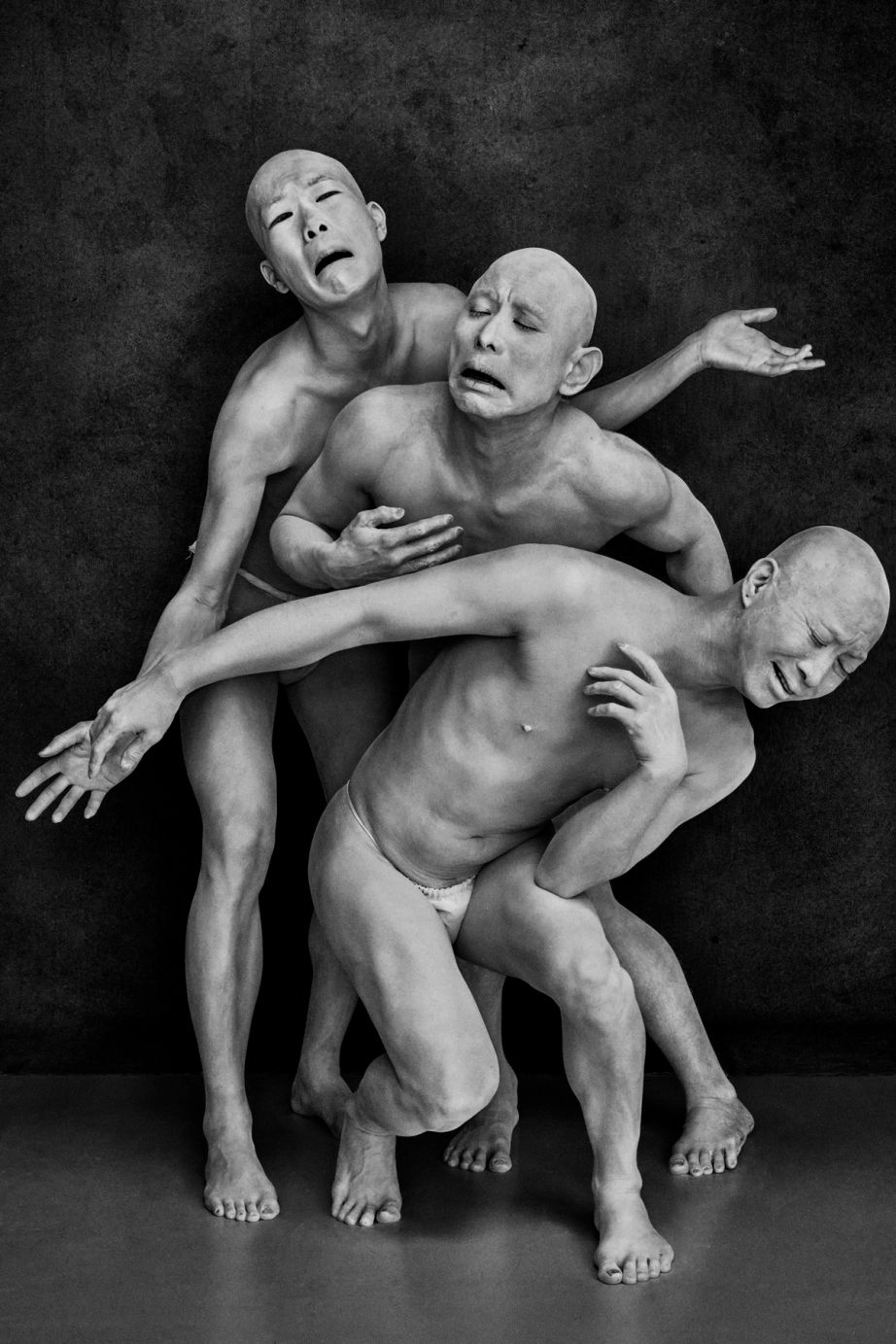
Dancers from Butoh Ishii Gumi photographed by Mario Testino, exploring the relationship between physical expression and collective movement.

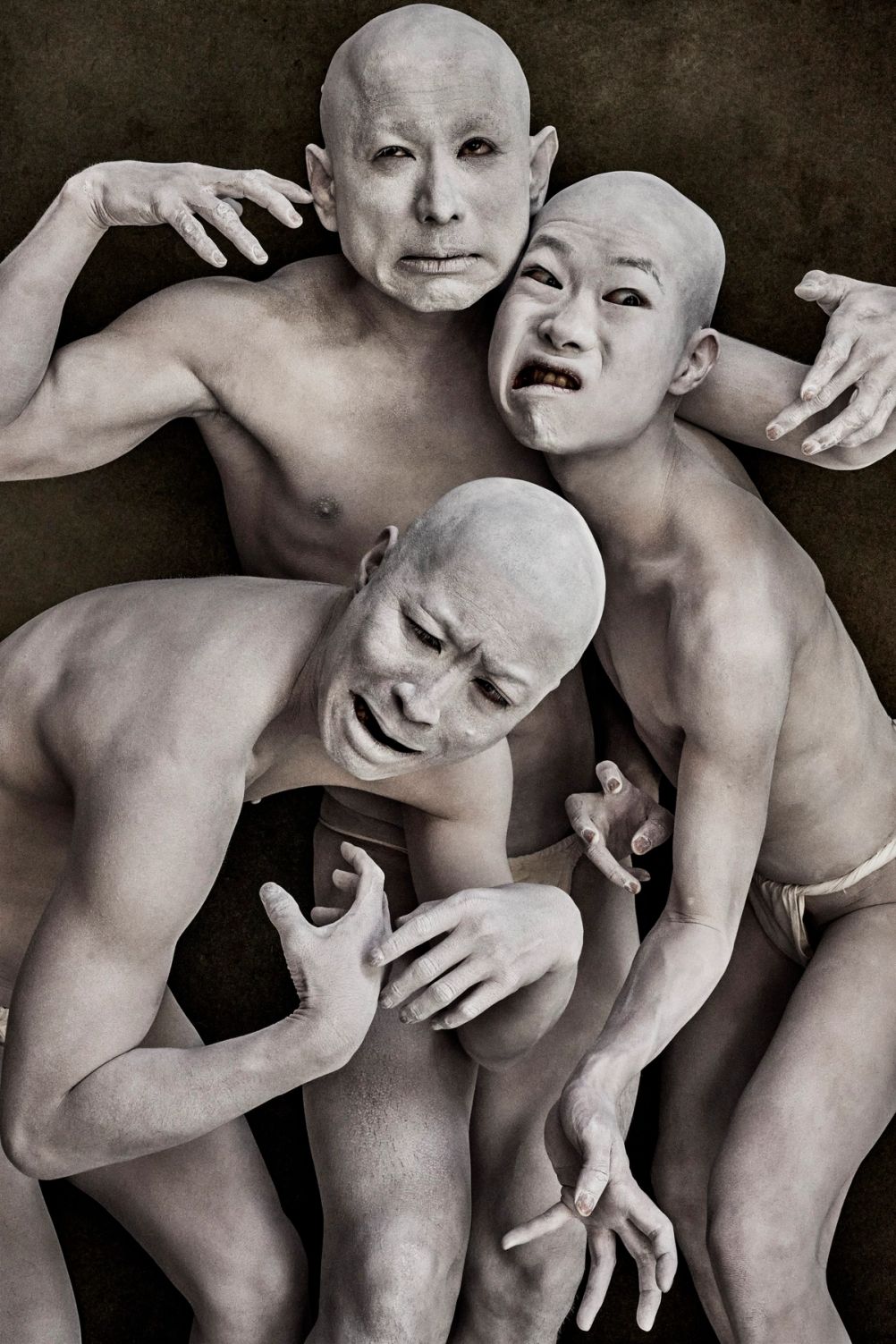
Butoh Ishii Gumi, Japan. Facial expression and gesture become central to the dancers' physical language in Mario Testino's photographs.
Norihito Ishii began as a B-boy, immersed in the explosive energy of breakdancing, where bodies defy gravity and movement becomes a display of extraordinary strength and control. He moved through hip-hop and contemporary dance, searching for new ways to express himself, to astonish, to hold an audience captive.
Then he encountered Sankai Juku, the internationally acclaimed Japanese Butoh company founded by Ushio Amagatsu in 1975. What he witnessed challenged everything he thought he understood about dance. Performers moved with almost unbearable slowness. A single step seemed to stretch time. The smallest gesture could command an entire room. Ishii was transfixed.
He had spent years discovering what the body could achieve through movement. Now he was discovering the power of almost none at all.
This was Butoh, a radical Japanese dance form born from the postwar avant-garde of the late 1950s. Pioneered by Tatsumi Hijikata and Kazuo Ohno, it rejected conventional ideals of grace and physical perfection. Bodies could be awkward, ageing, contorted or utterly still. Movement could emerge from memory, vulnerability or the darkest corners of human experience. Beauty was no longer confined to the beautiful.
Ishii went on to work with Sankai Juku before founding Butoh Ishii Gumi in 2019. His practice begins long before a dancer enters the studio. It begins with the almost imperceptible moments of everyday life.
A flicker of discomfort. A sudden sadness. The expression that crosses a face before its owner can explain what they are feeling. These are the things Ishii asks his dancers to notice. An emotion left unexamined disappears. An emotion truly observed can find its way into the body, becoming a gesture, a movement, an entire world.
And then there is imagination.
Ishii describes entering a lake that exists only in the mind. No water surrounds him. No shoreline lies ahead. Yet he reaches towards its surface, touches it and withdraws. The body has not left the room, but it has travelled somewhere else. Something invisible has acquired physical presence.
He calls this fantasy. The transformation of flesh and bone into something beyond their physical existence. Water. Air. The faintest residue of a feeling. In Butoh, the body becomes a vessel for what cannot be held, a physical expression of what cannot always be named.

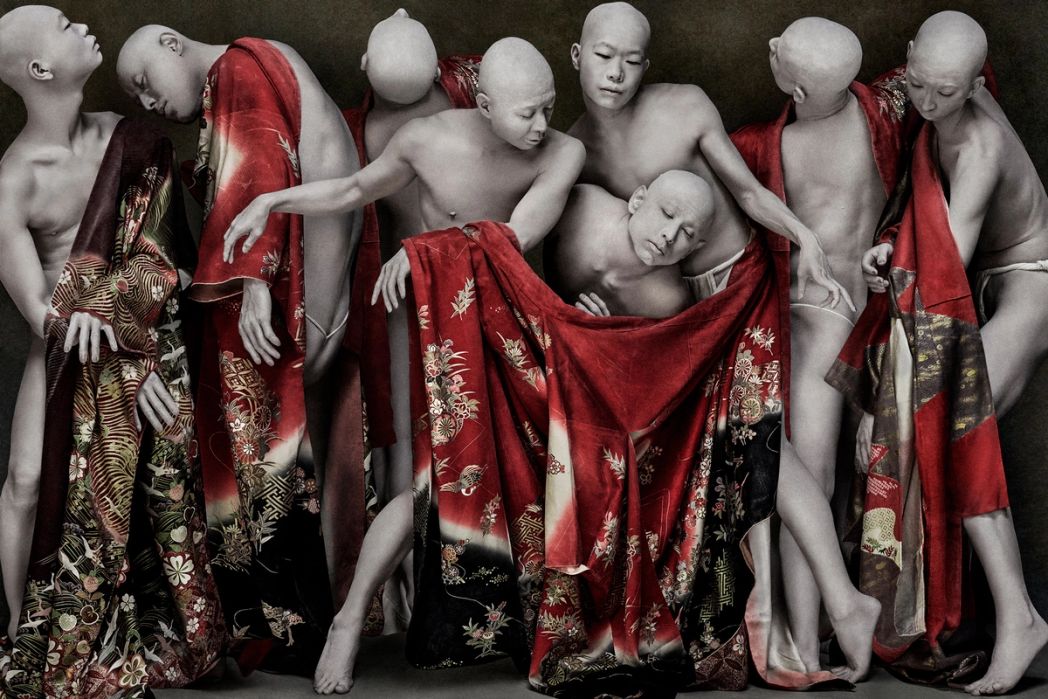
Butoh Ishii Gumi photographed by Mario Testino in Japan. The dancers form a collective composition of painted bodies, gestures and richly patterned textiles.
Seen through Ishii's philosophy, Mario's photographs reveal something beyond the extraordinary arrangement of bodies. Pale limbs emerge from richly patterned fabrics, arms reach towards unseen forces, and faces contort into expressions that hover somewhere between ecstasy and anguish. There is tenderness in one gesture, defiance in another. Nothing is entirely what it seems. Three bodies occupy the same space, yet appear to inhabit worlds of their own.
The white makeup, one of Butoh's most recognisable visual traditions, strips the faces of their familiar appearance. It is neither compulsory nor bound to a single meaning, but here it lends the dancers an almost otherworldly presence. Against the darkness, every curve of a shoulder, every parted lip, every outstretched finger becomes more pronounced. Flesh takes on the appearance of sculpture, yet the figures seem charged with life.
What makes these photographs so arresting is the uncertainty they preserve. Ishii believes that the meaning of a movement belongs as much to the person watching as to the person performing it. A gesture might evoke the force of wind, the weight of grief or a sensation for which language has no equivalent. Mario's camera does not resolve that ambiguity. It allows us to remain inside it.
For a photographer whose career has been devoted to exploring the human form and the many ways beauty reveals itself, Butoh presented an encounter with something that resisted familiar definitions.
“I have looked for beauty in a classical way for years. Discovering beauty elsewhere is always a treat.”
MARIO TESTINO
There is no conventional ideal to aspire to here. No demand for symmetry, elegance or perfection. The dancers surrender those expectations, allowing their bodies to become instruments of imagination, memory and feeling. Their extraordinary unity does not erase their individuality. Instead, each seems to give something of themselves to a form that could not exist without the others.
And perhaps that is the most extraordinary thing about these photographs. What begins as an encounter with something strange becomes an encounter with something deeply human. Beneath the white faces, the impossible gestures and the cascading fabrics are sensations we all recognise but rarely know how to express. Longing. Vulnerability. Surrender. The emotions that remain after words have failed.
Mario has photographed three dancers. Yet what we are left looking at is something far less easily contained: the invisible made visible through the human body.