WHY DO WE STILL LOOK AT FLOWERS? MARIO TESTINO, JAPAN AND THE ART OF LOOKING

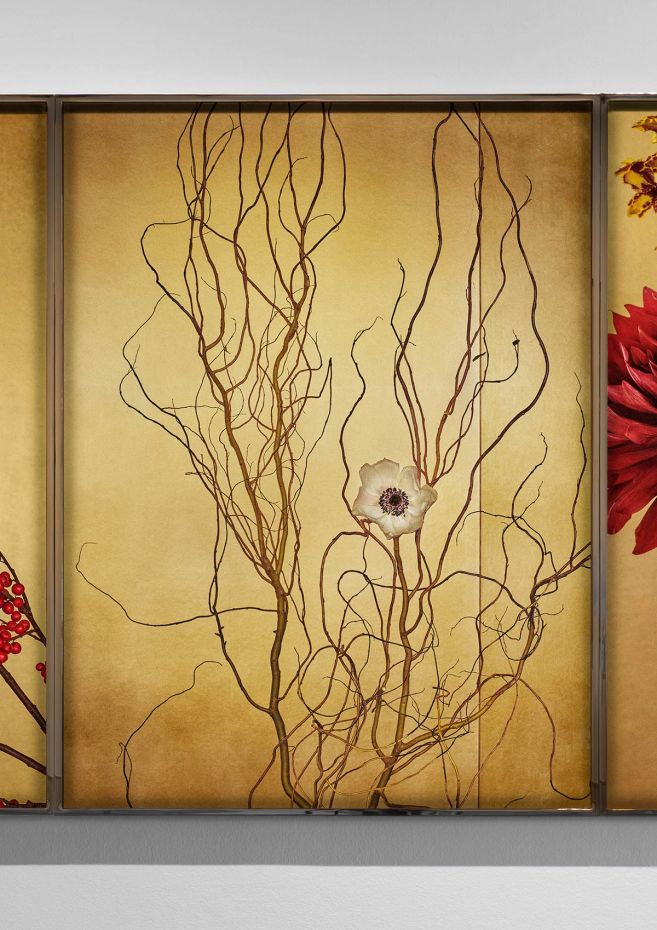
“Why do we still look at flowers and think they’re beautiful, even though we’ve seen them maybe a million times?”
It is a deceptively simple question, and one that Mario Testino began asking after more than four decades spent largely photographing people. Fashion had trained his eye on movement: a glance, a gesture, a dress caught at the right instant, the change that happens when another person enters the frame. His Japanese floral works presented almost the opposite problem. Flowers did not perform for him. They did not move at all.
“I wanted to understand the idea of still life, especially flowers,” Testino says. “I wanted to find a way of doing flowers that had the same energy that my fashion pictures had.”
Finding that energy meant reconsidering how a still life might behave. Rather than arranging flowers into a conventional centre, Testino began working through colour, scale and composition, allowing stems and blooms to rise, fall and interrupt one another. In his floral works, he explains, he wanted to break away from a predetermined shape, allowing the composition instead to be defined by where the eye stops.
The interest had been developing for years. Flowers had appeared throughout Testino’s fashion photography, often in relation to the person in front of his camera. He remembers the bougainvillea of his childhood in Peru particularly vividly. In Los Angeles, while photographing Daria Werbowy for American Vogue, he encountered red bougainvillea at the house where they were working and placed her in front of it. Flowers were still part of the setting rather than the subject. Today, that photograph hangs at Patricia Low Contemporary in Venice beside Tokyo (II), placing an earlier use of flowers in his fashion photography in direct conversation with the work that came later.

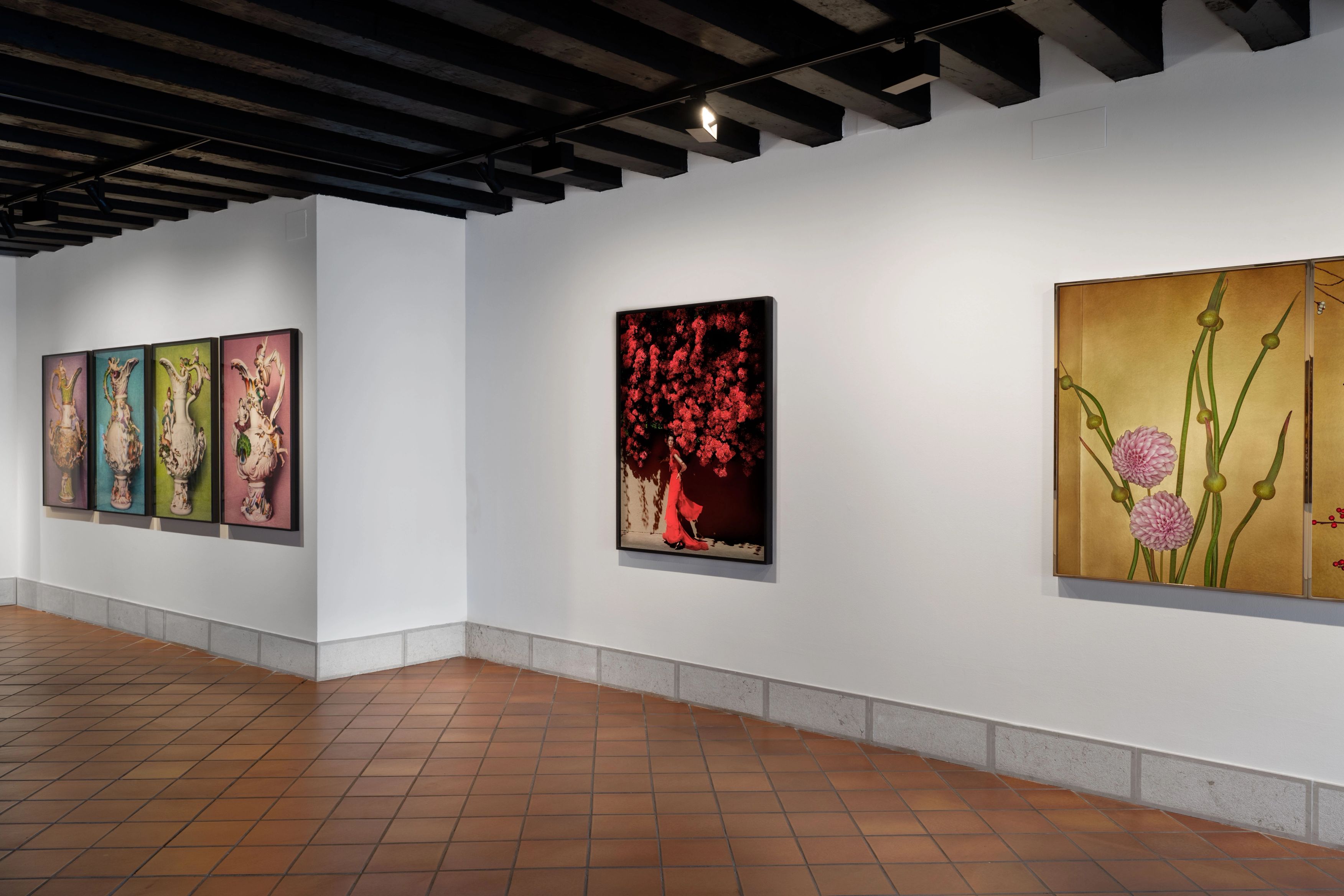
Installation view at Patricia Low Contemporary, Venice, 2026, bringing Mario Testino’s photograph of Daria Werbowy for American Vogue into dialogue with Tokyo (II), 2018–2019, and his Meissen works.
Then came a challenge. A friend suggested that perhaps he should not photograph flowers at all. The subject had been explored so extensively that finding anything new to say would be difficult.
For Testino, that made it more interesting.
The shift coincided with a change in the rhythm of his work. Away from the demands of fashion commissions, his curiosity expanded towards subjects he had previously passed more quickly: animals, plants, flowers, traditional dress and the forms he encountered while travelling. The camera remained the same instrument, but the pace of looking changed. In Venice, Testino described the distinction simply: fashion happened at speed; the work he makes today comes from contemplation.
During repeated trips to Japan, Testino found a florist whose abundance caught his attention. Returning in different seasons, he noticed the selection changing each time, but also the way flowers were presented. Some were brought together through colour, others through related forms. He became fascinated by what he describes as the “similarities and contradictions between them”, and asked a friend in Japan to help him begin photographing the flowers.
“I wanted to do my flowers in a new way of screens, not as dividers in rooms, but maybe as dividers for each flower to be appreciated singularly or in relation to the others.”
There was something unexpectedly familiar in this process. Testino had spent decades constructing images through the interplay of people, clothes and their surroundings. In Japan, he began noticing a similar visual exchange between flowers.
The reference has a specific history. Japanese folding screens, or byōbu, developed as both functional objects and important surfaces for painting. Across centuries, artists used screens to organise landscapes, flowering plants, birds and other seasonal imagery, including compositions extending across gold grounds. Their divisions allow an image to unfold through space while remaining a single object.
Testino does not reproduce a historic screen. He takes its proposition somewhere else.
Across the Japanese floral works, separation becomes a way of looking. A flower can occupy its own visual territory while remaining connected to what happens beside it. The eye travels across divisions, finding repetitions, differences and unexpected relationships. What once divided physical space now helps divide attention.

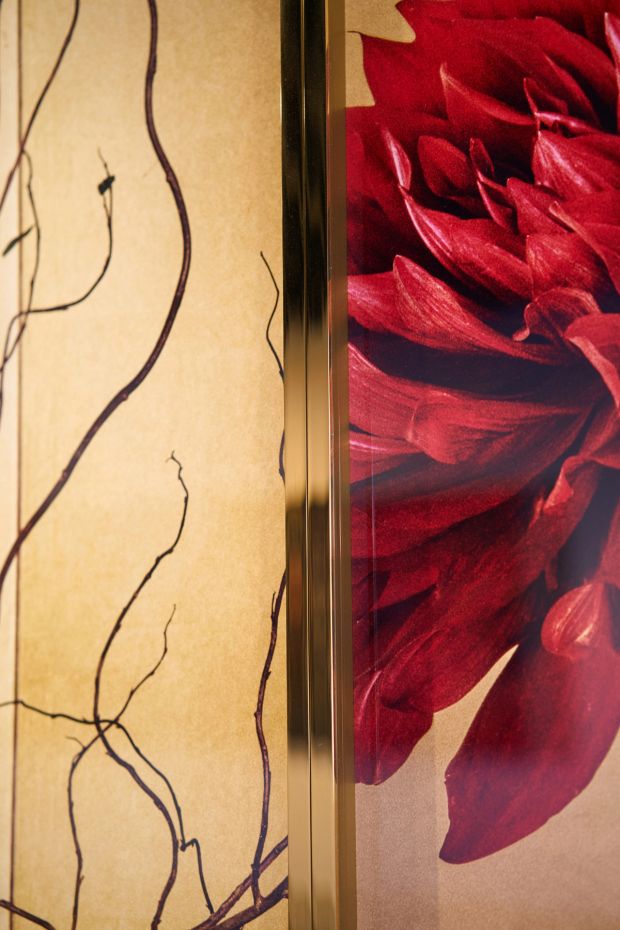
Detail of Tokyo (II), 2018–2019, where branching forms and saturated red flowers meet across adjoining panels.

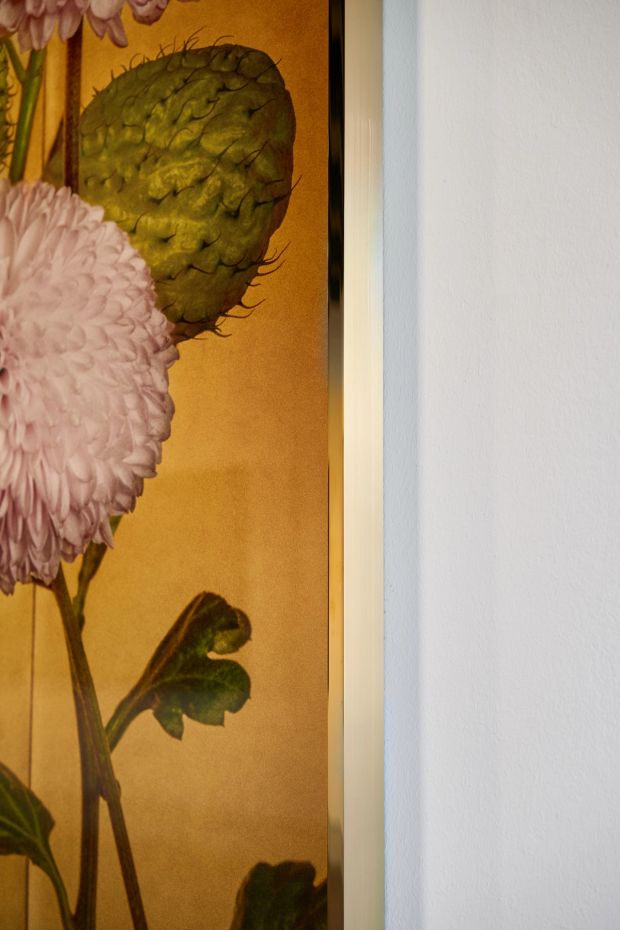
Detail of Tokyo (II), 2018–2019, revealing the botanical forms and gold ground of Mario Testino’s five-part Japanese floral work.

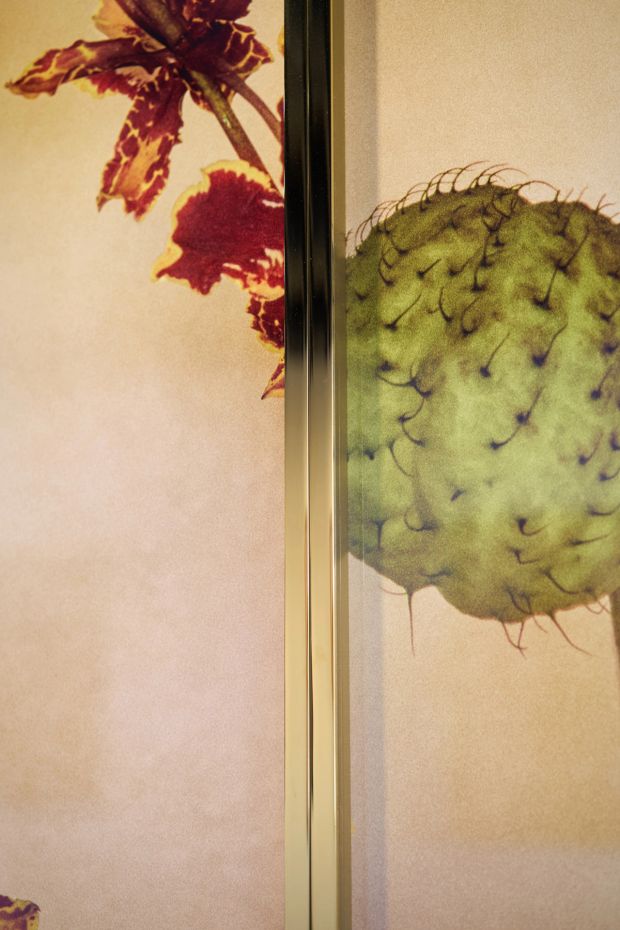
Detail of Tokyo (II), 2018–2019. Separate panels place individual botanical forms in relation to one another across the work.

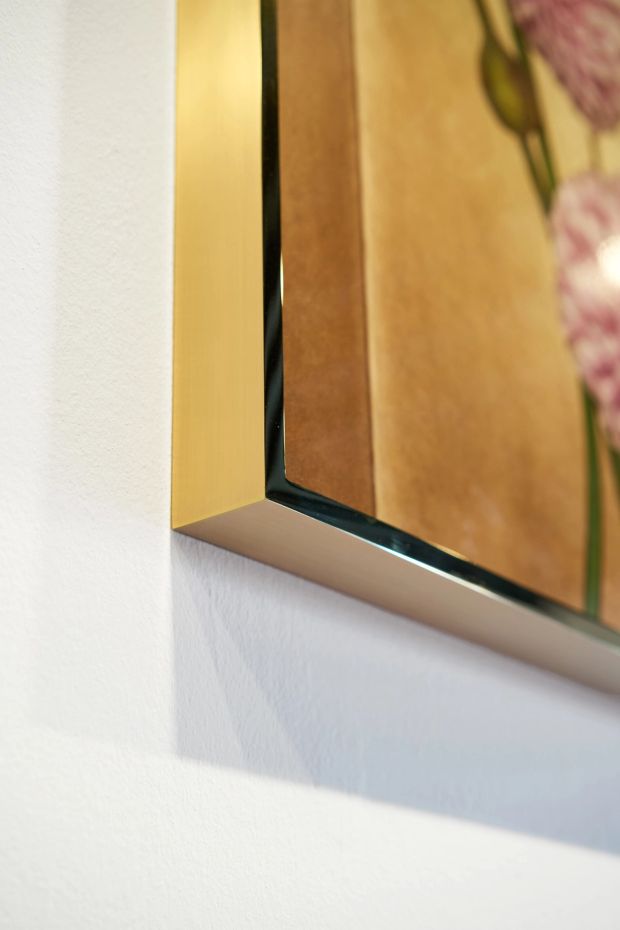
Detail of Tokyo (II), 2018–2019. The gold-toned frame extends the warmth of the photographic ground beyond the image.
When the works were exhibited at Hamiltons Gallery in London in 2019 as part of Mario Testino: East, the floral studies were shown alongside Testino’s portraits of Japanese men tattooed by Horiyoshi III. The exhibition brought together 18 works arising from different encounters with Japan, while the flowers themselves drew upon the visual language of Japanese art and decorative screens.
The gold ground is central to their effect. Against it, saturated colour becomes more intense while delicate stems and petals retain their fragility. The flowers are static, yet the compositions rarely feel still. Colour takes on some of the work once carried by clothes; composition begins to function like gesture.
This is where the apparent distance between Testino’s fashion photographs and his flowers starts to narrow.
Testino had never formally studied art history. After arriving in Europe as a young man, museums became part of his education, in part because they were places he could visit for free. He studied how groups were constructed in paintings and absorbed images of bodies, animals, fruit, plants and flowers. Years later, he came to recognise how much of what he had looked at remained somewhere in his visual memory.
The Japanese flowers did not emerge because Testino acquired a different eye. They emerged because the eye he had trained for decades was given another subject, and more time.
That evolution is particularly visible now in Venice. At Patricia Low Contemporary, Tokyo (II), 2018–2019 extends across the gallery wall in five C-type prints, each measuring 120 by 89.8 centimetres. Seen together, the panels form a single composition; move closer and that unity begins to fragment. A stem, a petal, an expanse of gold or the space between two flowers can suddenly become the thing that holds the eye. The work is shown alongside another five-part floral work made in London, photographs of horses from Uzbekistan, studies of Meissen porcelain and fashion images of Stella Tennant, Daria Werbowy and Vittoria Ceretti. It is the first time, Testino says, that he has brought his commissioned fashion photography and the work arising from his more recent personal curiosity together in this way.

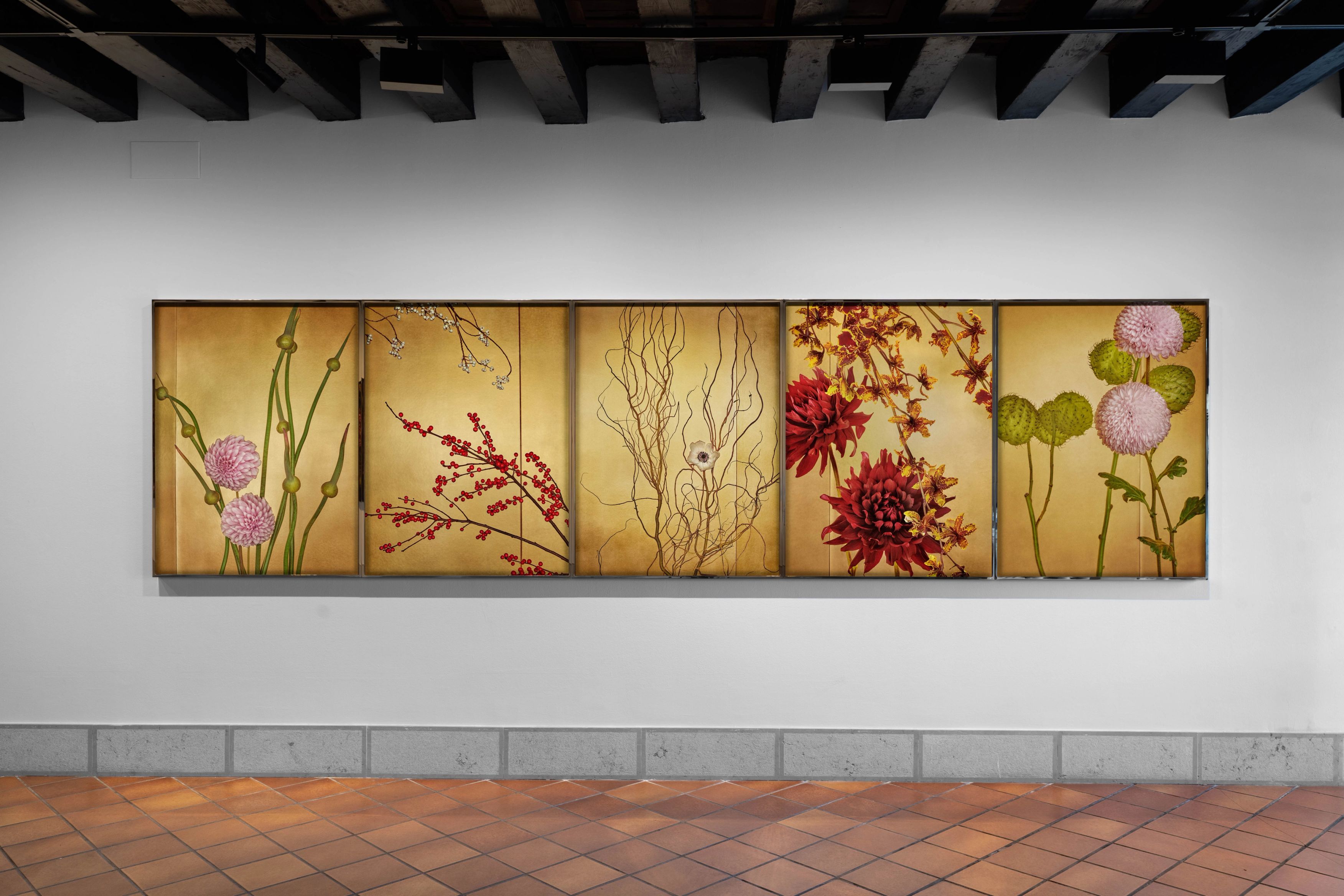
Tokyo (II), 2018–2019, Mario Testino. Five C-type prints, each 120 × 89.8 cm, installed at Patricia Low Contemporary, Venice, 2026.
“I actually exist as one person,” Testino says, describing his realisation that bodies of work he had once kept separate could instead be allowed to relate to one another. “That person has many curiosities.”
Seen in that context, the flowers become less a departure than an expansion. The fascination with colour remains. So does the interplay of elements inside the frame, the attention to form and the desire to give something familiar enough intensity that it commands another look.
The Japanese floral works have also found a life beyond the gallery. A monumental floral work from the wider series was recently featured by AD Middle East in an English manor reimagined by architect and interior designer Christophe Carpente, whose studio oversaw the architecture, interiors and art curation. Extending approximately four metres across the dining room, Testino’s work becomes part of the architecture of the space. Carpente describes each room as a conversation between architecture, furniture and artwork.
It is particularly fitting for works conceived through Testino’s interest in screens. Across multiple panels, a floral photograph can establish rhythm across a wall. Distance brings the composition together; proximity breaks it apart.
Which brings the work back to Testino’s original question.
Why do we still find flowers beautiful when we have seen them so many times?
His photographs do not need to make flowers unfamiliar in order to make us notice them. They ask something more difficult of us: to look closely at what we thought we already knew.
After a career spent learning how quickly to look, Testino discovered another possibility: staying long enough to see more.